
Just around a bend in the Gunnison River from the famous Painted Wall formation -- and really, a part of it -- resides this softly sunlight-spotlit, inverted chevron of resistant gneiss and schist, shot through by pegmatite veins. These patterns are just like much of the other walls in the region, with the same water-driven origin, cut about an inch deeper per year. Yes, those are mature trees … [Read more...]

Willow Fire after Two Weeks
Started about two weeks earlier by then-undefined human activity, the "Willow Fire" continued to burn through the San Isabel National Forest and nearby Mt. Massive Wilderness Area at the time of this wide-angle shot in mid-July, and into the following month. Mt. Massive, Colorado's second highest peak, is seen at left through smoke. Here, wind blew from the NNE, advecting smoke and embers across … [Read more...]

“Ground Scraping” Scud
Cool, moist air surged outward (leftward) from a newer rain foot at right, intersecting slower-moving outflow from a more distant part of the core behind the scud. With saturated air, relative humidity at 100%, at ground level in the outflow surge, lifting of that air into a drier environment just above only gradually eroded the fractocumulus scud, in fragments and turrets. The scud made a fine … [Read more...]
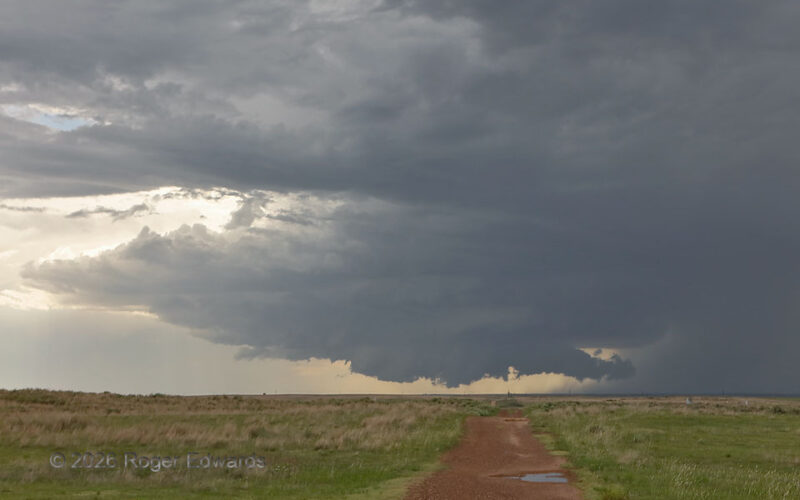
Tornadic Soon Signs
To no surprise of experienced storm observers, this supercell would produce a cone tornado soon, within the following 5-15 minutes. Clues -- some of which are visible here, others gleaned from observations afield -- included: * Storm persistence and growth for over an hour to this point, * Continually stronger rightward (southward) motion component... * Along a nearly stationary, … [Read more...]
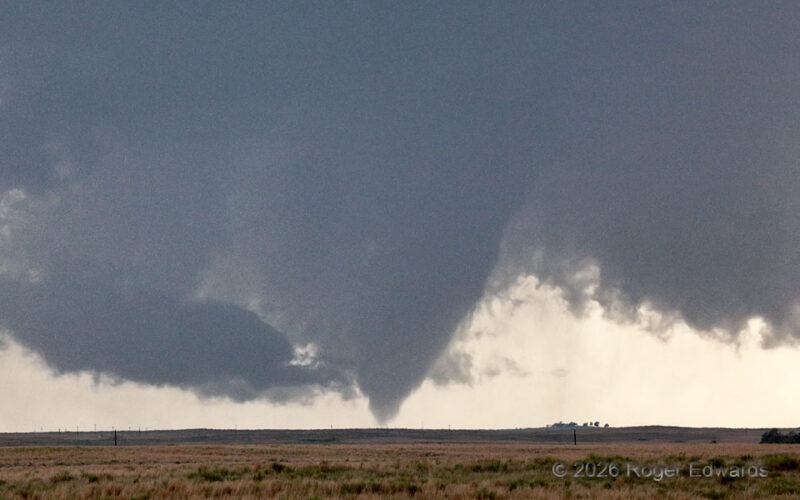
Beaver County Cone
Although the sweet storm structure before and after this was a highlight of the supercell's lifetime, its main tornado developed when the base was rather ragged, and the original, very low, surrounding wall cloud got chopped up into scud chunks by currents of variably distributed air properties wrapping inward from the rear flank, inflow and forward-flank sectors. Yet, that interaction clearly … [Read more...]
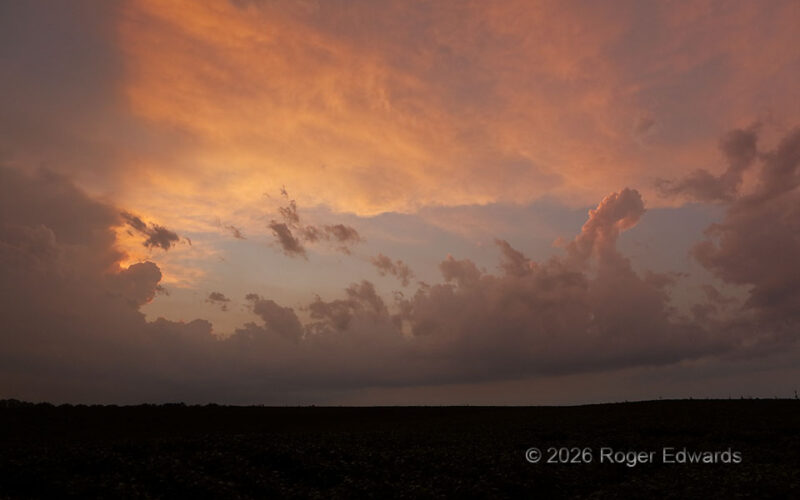
Eastern Iowa Sundown Sky
[Part 2 of 2] The storm complex responsible for all these clouds may have been weakening rapidly, but it left behind a marvelously complicated sky of cirrus and convective turrets for sunset illumination. Higher parts of a line of elevated towers also caught the last rays of the sun, adding color and texture to this peaceful scene. To the east, the deepest tower at left cast a shadow across the … [Read more...]
- « Previous Page
- 1
- …
- 3
- 4
- 5
- 6
- 7
- …
- 425
- Next Page »