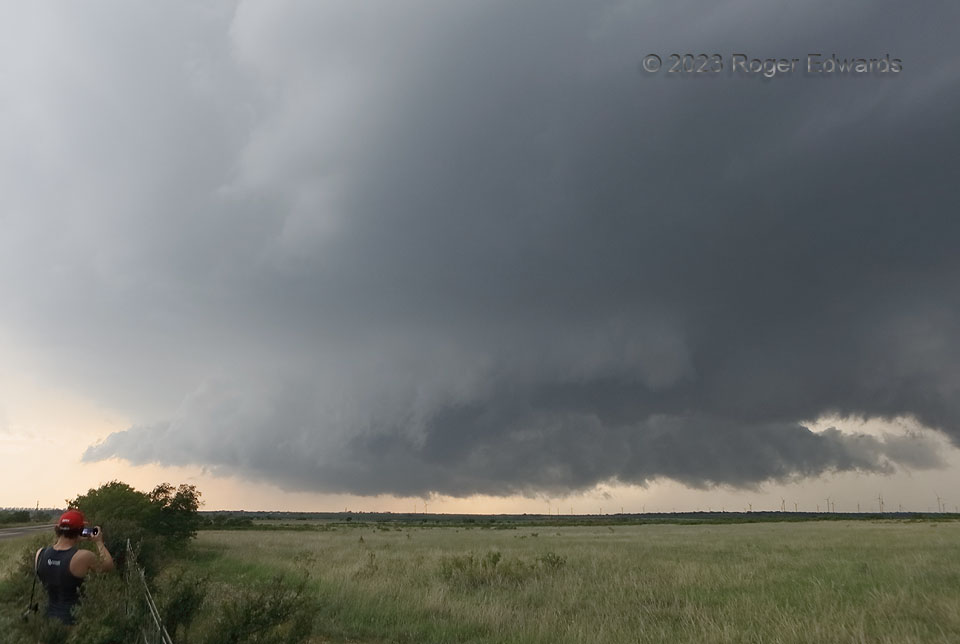
A low, ragged, broadly, moderately rotating, southeast-moving supercell base pulls tail clouds from the north (forward-flank) and south (inflow) sides, occasionally yielding a briefly tighter area of rotation that made us pay close watch beneath for debris spinups that never were seen. When the front part accelerated north, we thought tornadogenesis could be imminent, but within less than a minute, it decelerated again. [The observer at lower left is visiting Polish scientist Mateusz Taszarek.] We had watched this storm from its earliest cumulus stages to becoming a supercell, through present maturity on the Edwards Plateau, to its late stage and ultimate demise in the Hill Country. Despite its lack of tornado production, this was a fruitful and insightful storm-observing experience, as all full-lifecycle supercell intercepts are.
4 E Melvin TX (12 Jun 23) Looking WNW
31.1989, -99.5064