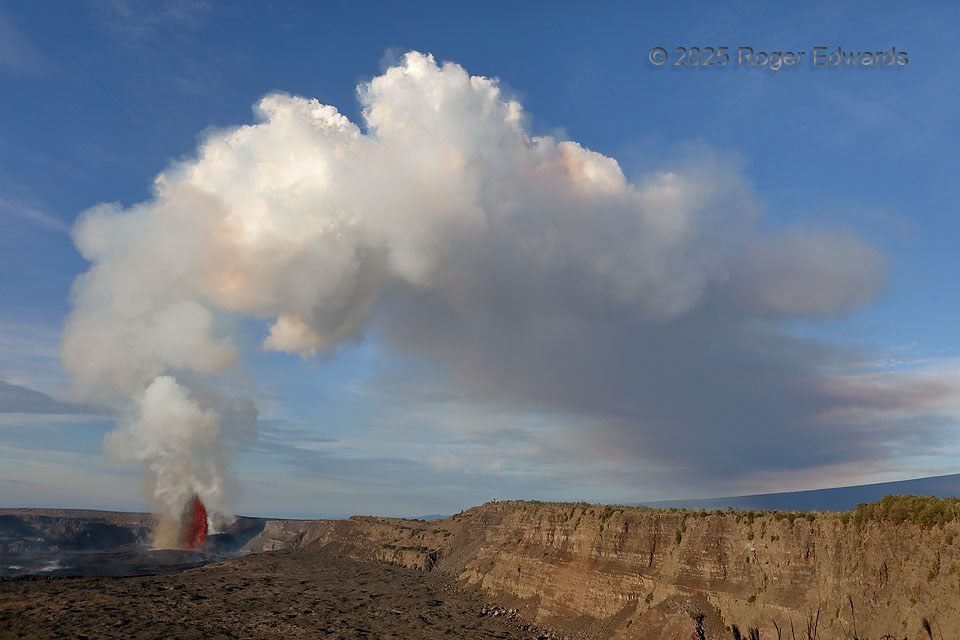
Pyroconvection doesn’t just happen from wildfires or rise from flames. Any extreme heat source can cause it, and this absolutely qualifies: a skyscraper-high fountain of lava hotter than 2,000 degrees F, shooting upward for hours from the southwestern floor of the Kilauea summit caldera. Continual landing of hot rocks on the crater floor raised large amounts of yellow dust that got drawn up into the rising column of hot gas, which also contained water vapor (much of which condensed as cloud), and an array of volcanic gases. That got caught up in the east-northeasterly tradewinds, advecting along the rest of the southern Big Island and dropping lightweight volcanic products such as scoria near the crater, and “Pele’s hair” (thinly filamentous volcanic glass) farther downwind. By this time, the fountain had been going for over three hours, including a spectacular sunrise, and had sent an “anvil” of fumes, dust and cloud well past the southern slopes of Mauna Loa, at distant right, and over to the southwest side of the Big Island. Material from this event and antecedent, simmering gas releases, contributed to one of many noxious episodes of a natural form of pollution known as “vog” in the lee of Mauna Loa.
3 W Volcano HI (19 Sep 25) Looking SW
19.4309, -155.2727