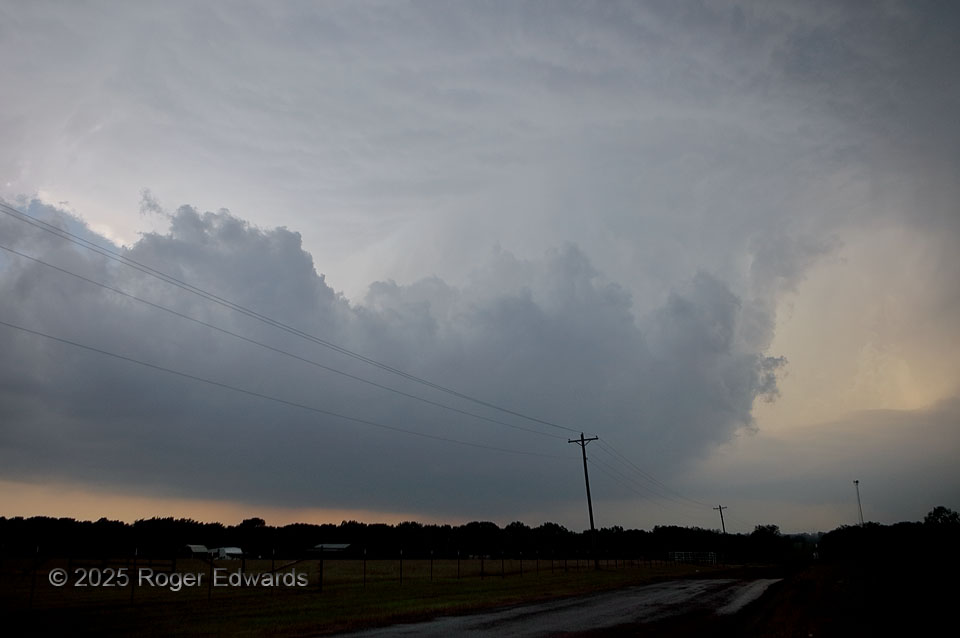
When someone asks me what I look for in a maturing supercell before it produces a tornado, I’ll describe something much like this: a very wide, but well-tilted updraft, large and low base, juicy moist environment (preferably along a diurnally baked baroclinic boundary for added low-level vorticity, as this was), not excessive precip behind (W or SW of) the updraft, a well-formed tail extending under or in front of the vault, and no other storms nearby to interfere. We had seen tornadoes the day before in the Missouri Bootheel region, then woke up soon after sunrise to drive 535 miles pretty much on the shortest possible route from Blytheville, AR, to here, just a county south of home. Still, we didn’t arrive in time for storm genesis, and given the large-buoyancy environment, I was concerned this supercell could go tornadic within less than an hour after it formed (we got here about then). Given the low LCL, high CAPE and strong low-level shear along the boundary, the “significant tornado parameter” (which I helped to develop) was increasing and in the 4 to 5 range already. I actually thought the storm underperformed its apparent environment, and was surprised that it took another half hour or so to produce only one small tornado!
1 E Paoli OK (17 May 25) Looking SW
34.8261, -97.235