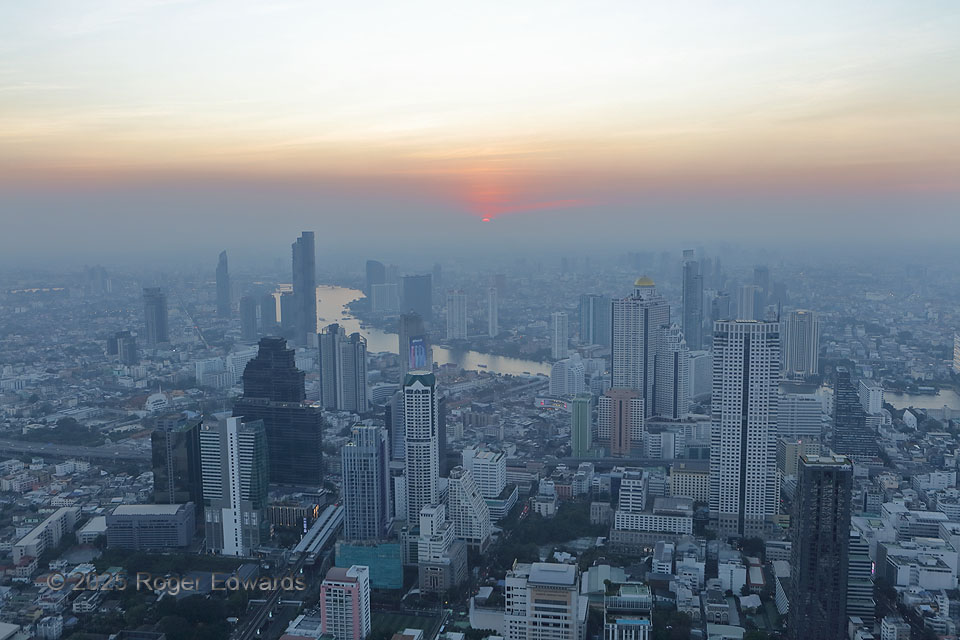
An otherwise modest sunset, amid thin cirrus, was made remarkable by the power of pollution: a dense boundary-layer haze common to Bangkok in the dry (winter) season. During this time of year, this massive city gets little rain, with the intertropical convergence zone (ITCZ) largely occupying the Southern Hemispheric tropics. When not flushed by remnant post-frontal gradient winds coming from the northeast across southeast China and Indochina, the boundary layer here in the Chao Phraya River delta can become stagnant beneath an inversion, similar to how some cities in basins like Denver and Los Angeles accumulate high airborne particulate content. It’s not just the cars, motorcycles, buses and tuk-tuks either; factories and agricultural burning up and down the nation’s central valley contribute to this condition. During the week of and after this shot, over 350 schools in the area had to close due to air pollution, with PM2.5 microparticle concentrations as high as 108 micrograms per cubic meter (21.6 times WHO safe-standard levels). View is from the 1,031-ft roof of the “King Power Mahanakhon” skyscraper, second tallest in the city by a small margin (12 ft) to the riverside tower at somewhat distant left, the “Magnolias Waterfront Residences at ICONSIAM.” Soon: a surprisingly colorful twilight scene!
Bangkok, Thailand (18 Jan 25) Looking WSW
13.7234, 100.5281